
I N C I N Q U E

Loading

Freight Billing Errors Are Costing Your Business More Than You Think

Freight Invoice Audit Services: Improve Billing Accuracy and Reduce Costs

Ask a freight broker how their billing is going and most will say “fine.” Ask them to pull up the last quarter’s disputed invoices, short-pays, and rebilled loads, and the picture often looks different.


Billing errors in freight are rarely dramatic. They’re small, a wrong rate here, a missing accessory charge there, a duplicate invoice that slips through. But freight runs on volume, and small errors at volume add up to numbers that genuinely affect the bottom line.

What Freight Billing Errors Actually Look Like in Freight Brokerage Operations

  • Rate discrepancies: The rate confirmed with the carrier doesn’t match what’s invoiced to the shipper, sometimes because of a data entry mistake, sometimes because of a miscommunication during booking that never got corrected in the system.
  • Missing accessorials: Detention, layover, fuel surcharges, lumper fees, these get negotiated verbally or via text and don’t always make it into the invoice. The carrier expects payment for them; the shipper isn’t billed for them. Someone absorbs that gap, and it’s usually the brokerage.
  • Duplicate billing: A load gets invoiced twice, once manually and once through an automated process, or once by two different team members who didn’t realize the other had already handled it.
  • Incorrect weight or mileage calculations: When rates are calculated per mile or per hundredweight, small errors in the underlying numbers compound across every invoice using that calculation.
  • Unbilled loads: Loads that were delivered, confirmed, and never invoiced at all, sitting in a gap between operations and accounting, generating zero revenue until someone notices.

The Direct and Indirect Costs of Freight Billing Errors

Industry estimates for freight billing error rates typically fall between 5% and 10% of total invoices having some kind of discrepancy. For a brokerage processing $2 million a month in freight, even a conservative 3% error rate in missed charges represents significant monthly revenue leakage.


Not all of that revenue is permanently lost, some gets caught and corrected. But the time spent catching and correcting it is itself a cost, and a meaningful percentage of errors never get caught at all.


Cash flow delays create another issue. Shippers don’t usually pay invoices with discrepancies until everything is resolved, which slows down receivables and creates pressure on working capital.


Carrier relationships also suffer. When carriers repeatedly deal with payment disputes caused by billing mistakes, trust erodes quickly. Reliable carriers remember which brokers create unnecessary payment problems.


Every disputed invoice also requires manual work, reviewing rate confirmations, PODs, carrier communication, and invoice details. That’s skilled staff time spent fixing preventable issues instead of generating new revenue.

Why Freight Billing Errors Keep Happening Across Logistics Teams

The root cause is usually the same: billing information passes through too many hands and too many systems without a single source of truth. A rate gets negotiated by phone, entered into a spreadsheet, re-entered into the TMS, and later pulled into an invoice. Every handoff creates another opportunity for something to get missed or entered incorrectly.


The companies that reduce billing errors successfully aren’t always the ones with the most advanced software. They’re the ones with disciplined processes, consistent documentation, centralized records, and invoice review steps before billing goes out.

Incinque Business Solutions: Freight Billing Done Right

At Incinque Business Solutions, our logistics support team handles freight billing and invoicing for US brokers and 3PLs, reconciling rates against confirmations, catching accessorials before invoices go out, and following up on unbilled loads before they fall through the cracks.


We understand freight billing because we’ve built our team around it. If freight billing errors are quietly costing your business revenue, delaying cash flow, or damaging carrier relationships, Incinque Business Solutions can help you create a cleaner and more reliable billing process.
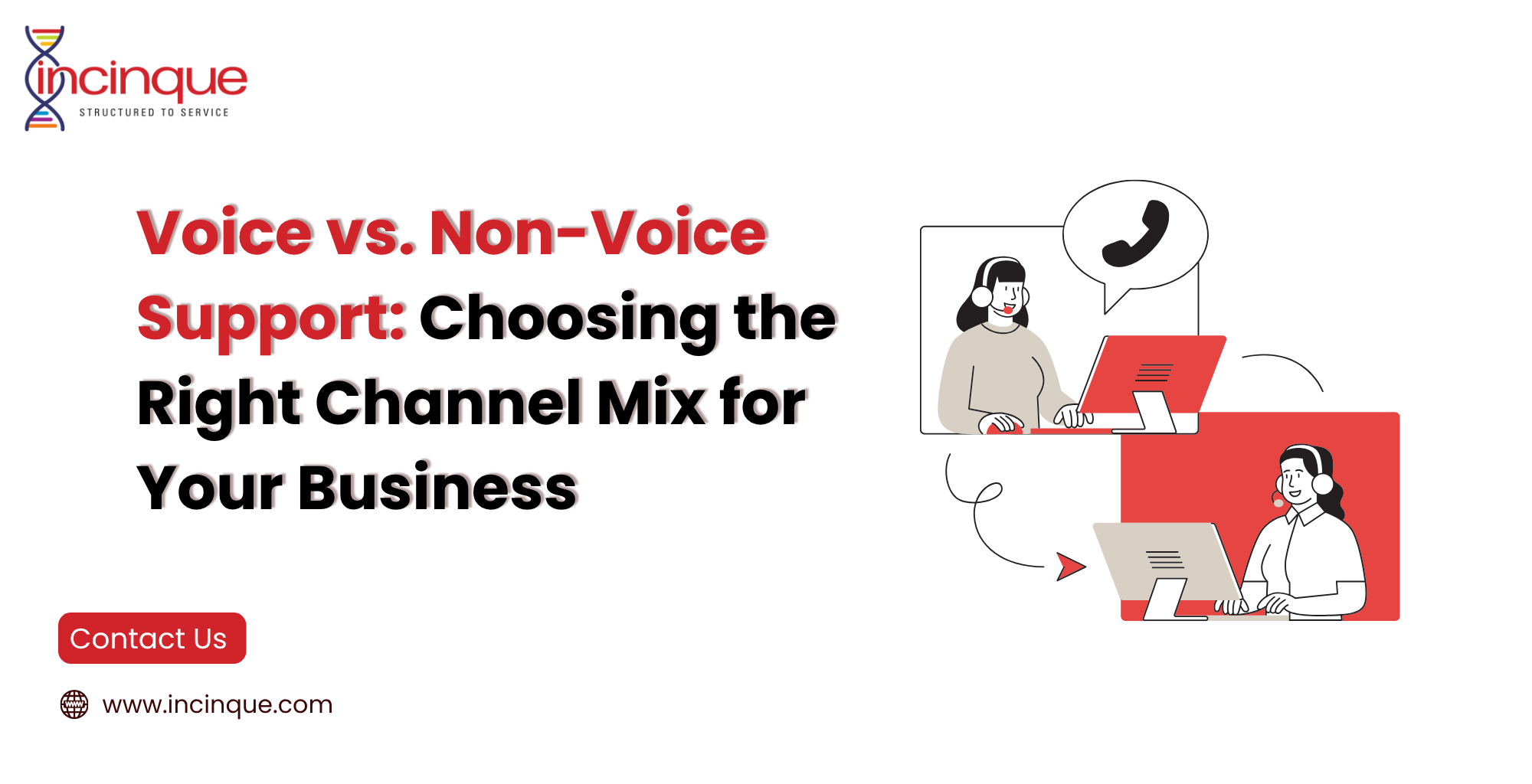
Voice vs. Non-Voice Support: Choosing the Right Channel Mix for Your Business

Customer support banner comparing voice and non-voice support with call center agents using headsets and computers.

Every business reaches a point where “just have them call us” stops being a complete answer. Customers are contacting you through too many different places, expecting too many different things, and your support team can only handle so much before something slips.


The voice vs. non-voice conversation comes up at that point, and it usually starts with someone saying “can’t we just do chat instead of calls?” The honest answer is more nuanced than yes or no.

What Voice Support Actually Is (and Isn’t)

Voice support means phone calls. A customer calls, a human answers, the issue gets discussed and ideally resolved in real time.


It’s immediate. It handles complex situations well, the ones where typing out a problem would take ten minutes but explaining it takes two. It’s also what many customers default to when they’re frustrated, because there’s something about speaking to a person that email and chat can’t fully replicate.

The limitations are real too. Phone support doesn’t scale cheaply. Each call requires one agent’s full attention for its entire duration. There’s no parallel handling, one agent, one call. Peak volume periods create queues, and queues create unhappy customers before anyone’s even spoken to them.


For businesses dealing with high-stakes situations, financial disputes, medical queries, escalated complaints, voice support is often non-negotiable. The customer needs to feel heard, and that requires a conversation.

What Non-Voice Support Covers

Non-voice support includes email, live chat, SMS, WhatsApp, social media DMs, and any channel that doesn’t involve a real-time verbal exchange.


The advantages are significant. A single agent can manage three to five live chat conversations simultaneously. Email support allows agents to research, verify, and draft careful responses without the pressure of a live call. WhatsApp has become the default support channel for enormous segments of the Indian market. Social DMs matter for brands with active social presence because public complaints, handled well, are visible to everyone.


Non-voice also creates a natural paper trail. Every interaction is documented without effort, which matters for follow-ups, audits, and quality reviews.

The limitation is handling complexity. A technical issue that takes two back-and-forth emails to explain is costing more time than a five-minute call would. Tone is also harder to read, a frustrated customer on chat can escalate quickly when they feel like they’re talking to a bot or a script.

The Real Question: What Do Your Customers Actually Use?

This is where most businesses go wrong. They design their channel mix around what’s convenient to operate rather than what customers naturally reach for.


A 65-year-old calling about a utility bill issue is not going to use live chat. A 28-year-old with a software query isn’t going to pick up the phone if there’s a chat option. A business buyer with a complex service complaint needs a phone call, not a ticket number.


Your customer profile determines your channel mix, not the other way around. The data you need to look at: what channel do inbound contacts currently arrive through? Where do resolution rates drop? Where are response times lagging? Those numbers tell you what’s working and what isn’t.

The Case for a Blended Model

Most businesses land on a blended approach, and for good reason. Voice handles the complex, emotional, and high-value interactions. Non-voice handles the high-volume, transactional, and asynchronous ones. The two aren’t in competition; they’re covering different parts of the same customer journey.


The mistake is running them as separate functions that don’t talk to each other. A customer who called yesterday and now sends an email expects whoever answers to know the history. If your voice and non-voice teams operate in silos, that expectation goes unmet, repeatedly.


Integration between channels, shared access to interaction history, and consistent training across both functions are what make a blended model work. Without those three things, you have multiple channels but not a coherent support operation.

Build the Right Support Mix with Incinque Business Solutions

At Incinque Business Solutions, we design and deliver blended customer support operations, voice and non-voice, for businesses that need both done well. Our agents are trained across channels, briefed on your products and tone, and set up to handle the full range of your customer interactions. Whether you need to add phone coverage, scale your chat support, or integrate both into a single operation, we build around what your customers actually need. Let’s talk about what the right mix looks like for your business.

Load Board Management: Why US Freight Brokers Are Outsourcing It

Load board management for US freight brokers with logistics professional and shipping icon.

Just ask a veteran freight broker how they keep up with their jobs amidst the daily hustle and bustle of running the business and they will invariably tell you the same thing – managing the logistics that build the business is getting pushed aside all too frequently by the logistics of simply keeping the business running.


Load board management fits solidly into the latter camp. Critical, time-consuming, recurring, and almost always far from the highest and best use of the broker’s time.


This is what it entails, why brokers are starting to outsource it, and how it should be outsourced.

What Load Board Management Actually Involves

To those unfamiliar with freight operations, a load board refers to an online marketplace where brokers list loads and carriers look for freight suitable for their trucks, lanes, and schedules.


It appears like a straightforward business. In reality, operating load boards in large numbers entails non-stop work:


  • Listing loads: Each available load must be listed correctly – the pick-up location, destination, weight, equipment type, cost, and window period. Listing a load incorrectly consumes everyone’s valuable time and hurts one’s credibility with carriers.
  • Refreshing and monitoring: Posts on load boards gradually sink below the threshold over time. Effective management entails refreshing posts, renegotiating prices in case the load does not receive attention, and eliminating posts where a load has already been covered elsewhere.
  • Handling of the phone calls and messaging: All these phone calls and messages are from the carriers about each of the posted loads since the carriers will call to ask whether the load is available for pickup, how much they would pay for the same, and other issues about the load.
  • Qualifying the carrier: Some of the requirements could have been set for your firm. Without having verified such aspects as the license, insurance, and safety rating of a truck, you cannot book him/her.
  • Updating the TMS system: The decision made should be entered into the system and load status updated. Failure to keep track of what’s happening at the boards through an accurate reflection on the TMS is like running blindly.


These procedures are fairly easy; it only requires much time – especially when dealing with loads in the region of fifteen or twenty.

Why Brokers Are Outsourcing It

Mathematical logic dictates that a US-based freight broker, who has to pay around $55,000-$65,000 per year for a full-time employee coordinating the operation of load boards, can easily delegate this task to an efficient BPO for significantly less money — up to 60-70% less.


Cost is just one aspect of the equation, though. The other aspect is coverage hours.


If a freight brokerage works according to the schedule from 8 AM until 6 PM Central Standard Time, it will need someone to coordinate loads at 10 PM once the customer calls right after finishing the delivery process. This can be conveniently done by outsourcing a team from another time zone.


Scalability is yet another important consideration. The moment a new shipper account appears or a peak season begins, load board traffic can double overnight. It is much easier to scale up a BPO service than to hire and train additional personnel in house.

What Good Outsourced Load Board Management Looks Like

The key is “trained.” Generic BPO teams who have not had any experience working in the freight industry cause more harm than good. Load board teams who are not knowledgeable about dry van versus reefer requirements, are clueless on reading a safety score, and don’t have any idea how to navigate around the TMS system are going to cause a lot of trouble for your company and carrier partners.


However, there is the other end of the spectrum, where you have dedicated freight logistics BPOs who can work with freight brokers and have experience working with DAT and Truckstop, MC number checking, and TMS systems such as McLeod, Tai, or Mercury Gate.


Onboarding will still take some time but much less when compared to non-freight teams. Also, there will be fewer mistakes when you onboard a logistics BPO.

Incinque Business Solutions: Logistics BPO Built for Freight

Our logistics support staff at Incinque Business Solutions has hands-on experience working directly with US freight brokers and 3PLs in managing the load boards, carrier communication, TMS data entry, and even working outside normal business hours. We know what freight entails – the software, the jargon, the processes – because we have hired our logistics support staff with these qualifications in mind. Your coordinators do not need to spend their days refreshing loads; let’s discuss that.

What Is a Marketing Funnel and How Do You Build One That Actually Converts?

Marketing funnel illustration showing analytics, customer journey, and conversion strategy elements.

Most people have seen the funnel diagram. Wide at the top, narrow at the bottom, with stages labeled something like Awareness, Interest, Consideration, Decision. It looks clean and logical on paper.

What nobody tells you is that building one that actually works, where real people move through each stage and end up buying, is a completely different exercise from understanding the concept.

Here’s what a marketing funnel actually is, why most of them underperform, and what it takes to build one that doesn’t.

What the Funnel Represents

A marketing funnel is a way of mapping how strangers become customers. At the top, you have people who’ve never heard of you. At the bottom, you have people who’ve just paid you money. Everything in the middle is the process of moving them from one to the other.

The reason it’s called a funnel is simple: more people enter at the top than exit at the bottom. Most drop off somewhere along the way, they lose interest, get distracted, find a competitor, or simply weren’t the right fit to begin with. The goal isn’t to eliminate drop-off entirely. It’s to reduce it at each stage and make sure the people who do exit aren’t leaving because of something you could have fixed.

The Three Stages That Actually Matter

Forget the five-stage academic version for a moment. In practical terms, every funnel has three zones:

Top of Funnel: Awareness. This is where people first encounter you. A blog post they found through Google. A LinkedIn ad. A friend’s recommendation. A podcast you appeared on. At this stage, they’re not thinking about buying. They have a problem or a question, and you happened to show up with something relevant.

Your job here isn’t to sell. It’s to be useful enough that they remember you and come back.

Middle of Funnel: Consideration. This is where things get interesting. The person knows you exist. They’re evaluating whether you’re the right solution. They’re reading your case studies, watching your demo, comparing you to competitors, maybe signing up for your email list.

Most businesses lose people here, not because the product is wrong, but because the content is either too salesy or too thin to actually help someone make a decision. What works at this stage is specificity: detailed guides, real results, honest comparisons, social proof that feels genuine rather than polished.

Bottom of Funnel: Decision. The person is close. They’ve done their research. Now they need a reason to act, and just as importantly, they need the friction removed. A confusing checkout, a slow response to a sales inquiry, a pricing page that raises more questions than it answers, any of these can kill a conversion at the last step.

Testimonials, clear pricing, a strong guarantee, and a frictionless next step are what move people from “almost” to “yes.”

Where Most Funnels Break Down

The most common failure isn’t a bad product or weak advertising. It’s a gap between stages.

A business runs great awareness content but has nothing to offer when someone wants to go deeper. Or they have a strong bottom-of-funnel offer but no way of warming people up before they hit it. Or they drive paid traffic directly to a homepage that wasn’t designed to convert anyone who doesn’t already know them.

A funnel that converts is one where each stage flows naturally into the next. The awareness content creates curiosity. The consideration content builds trust. The decision content removes doubt.

Consistency Is the Part No One Wants to Hear

Building a funnel isn’t a one-time project. The awareness content needs to keep coming. The email sequences need testing and updating. The conversion rate at the bottom needs monitoring and improving.

Most funnels that fail don’t fail because they were poorly designed. They fail because they were built once and then left alone. The businesses that get consistent results from their funnels are the ones treating them as ongoing systems, not campaigns with an end date.

Build a Funnel That Actually Works with Incinque Business Solutions

At Incinque Business Solutions, we build marketing funnels for B2B companies that do the full job, attracting the right audience, nurturing them through the consideration phase with content that actually earns trust, and converting them with messaging that removes friction rather than adding it. From demand generation and SEO to email sequences and conversion-focused web design, our team handles the pieces that most businesses struggle to connect. If your current funnel is losing people somewhere in the middle, or you don’t have one at all, let’s fix that.

After-Hours Customer Support: Options for Businesses That Can’t Go Offline

Incinque customer support agent providing after-hours business chat assistance.

There is also a special frustration of contacting a company about an issue – be it a billing problem, technical difficulties, or anything else of importance – only to get a canned response saying that your representative is available on weekdays between 9 am and 5 pm.


If you are the customer, you’ll be frustrated. If you are the company, you’ll lose something valuable – whether it is a chance for further communication, an ongoing relationship with the client, or even a customer itself.

For those companies working in different time zones, those running subscriptions, providing an ecommerce platform, or operating within industries when problems don’t sleep until morning – being unavailable outside regular office hours means losing a competitive edge.


Here is an example of how this can actually work.

Automated Chatbots: Fast, Limited, and Often Frustrating

A chatbot is usually the very first thing that any business opts for. Chatbots are cheap to deploy, operate continuously, and deal with a remarkable number of queries — inquiries about an order status, personal data retrieval, FAQ responses, and basic technical support.


When dealing with low-complexity queries at great volume, a good chatbot definitely deserves a spot on your support list. However, from the moment the customer’s problem is not included in the decision tree, the experience becomes completely frustrating. People easily recognize chatbots and will tolerate them up until a certain limit.


The best use case for the bots is to handle low-complexity tasks as a first-level agent while the more serious problems are passed down to human operators. Relying solely on chatbots as a backup solution for high-valued clients would be a risky approach.

Email Support: Available, but Not Actually Real-Time

An email address for after-hour contact is certainly better than nothing. Slightly.


The key issue is one of managing expectations. Customers sending emails late in the evening hoping that they will be answered by morning are often disappointed. Time passes, frustrations increase, and when someone does finally contact them, their opinion of your company has been made.


E-mail is effective in documenting conversations and providing a backup system. It is not effective in providing immediate after-hour support to companies that depend on it.

On-Call Internal Staff: Expensive and Unsustainable

Businesses address the issue of after-hours availability by employing an internal rostering system whereby one employee is always in possession of the company telephone and another one is always available, technically speaking.


While this seems a feasible solution to begin with, this only works up until you implement it for about six months; then your employees get burned out. Gaps in coverage emerge. Quality employees leave because they do not have to work during night time anymore. Paying these people for their after-hours availability gets increasingly expensive.


On-call makes sense when addressing emergencies, but not in regard to after-hours support.

Outsourced After-Hours Support: The Model That Actually Scales

A support team outsourced purely for after-hours help is a very neat way of tackling the situation. Your clients get human representatives when you’re asleep and your internal teams are off duty and unable to help due to lack of knowledge about your products and customer communication protocol.


The most important factor distinguishing this solution from any generic phone answering services is contextual understanding of the nature of the calls your company receives. An outsourced call center which was set up properly will know your customer base and be able to solve their problems, not merely record their message and call back later.


The approach is particularly effective in cases of companies operating in the US or Europe whose customer support needs are provided from a different time zone.

What to Think About Before You Choose

Of course, the answer lies in your after-hours tickets, the nature of your customer problems, and what your customers really want from you.


A software-as-a-service company servicing enterprise clients will have different needs compared to an e-commerce company dealing with refund requests. But what they have in common is the fundamental truth: the companies that are available for their customers when they need them earn their loyalty more than those who aren’t.


After-hours availability is becoming a distinguishing factor, not a luxury.

After-Hours Support That Works Like Your Own Team

Incinque Business Solutions is proud to offer your company off-hour customer service for any company who simply can’t afford downtime. Our representatives are familiar with your product lines, your processes, and your voice so that the customers never feel the transition. Be it evening customer support, weekend customer care, or a complete 24-hour service, we work with what you need, not what others tell you need.

What Does a Logistics BPO Actually Do? A Plain-Language Breakdown

A logistics BPO support agent wearing a headset and working on a computer.

Anyone involved in the transportation or logistics industry has almost certainly encountered the term “logistics business process outsourcing” at least once in conversations where “efficiency” and “cost savings” are frequently mentioned but nobody bothers to find out what exactly happens inside the business processes.

Here’s a straight-to-the-point explanation of what happens.

A logistics BPO business assumes responsibility for certain back-end processes that a freight broker, trucking firm, or 3PL would normally perform within their organization. They do not drive the trucks; they do not make dispatch decisions; but they do manage all processes required to enable these functions – from data entry to billing and communications – taking up countless hours every day.

The Work That Doesn’t Move Freight but Has to Get Done

This is something that only comes into perspective when one is in the middle of it – a lot of logistics activities are not related to physical transport.

Consider a small freight brokerage company. On any particular day, their back office staff are doing everything from confirming loads, requesting proof of delivery, feeding the data into the TMS system, verifying the insurance certification of carriers, dealing with invoice disputes, and answering inquiries by carriers regarding payments.

None of the above activities physically transports anything. If they get delayed or messed up, it will have consequences like untimely invoicing, dissatisfied carriers, and billing issues that can take weeks to resolve.

This is precisely what logistics BPO services address.

What Specifically Gets Outsourced

The specific list can vary depending on the firm, however, the main tasks transferred to the logistics business process outsourcing usually include:

  • Freight billing and invoicing: Preparing invoices, calculating freight billings, resolving any issues with rates, and pursuing any payments past due. Freight billing mistakes happen quite often and result in significant costs – having a specialized team devoted to solving only this issue lowers the risks of making mistakes and expedites the process of collecting bills.
  • Documentation handling for proof-of-delivery: Collecting documentation from carriers, verifying it against shipping documentation, and filing the documentation. The task is repetitive in nature and can easily be outsourced.
  • Carrier onboarding and compliance: Creating carrier accounts in the system, obtaining W-9 form, verifying their insurance certificate and FMCSA authority. Every 3PL firm and broker require this process, which takes lots of time and isn’t worth senior employees’ attention.
  • Managing load boards: Placing loads, answering carrier questions, and dealing with coverage on open lanes. If you are working with high volumes, then alone this is enough reason to outsource.
  • Data Entry and Transportation Management System: Data entry and creation of reports for an updated transportation management system. This job may seem boring but is vital for business operations.
  • Customer service and carrier support: Dealing with incoming queries via phone and email and providing status updates on shipments. Outsourcing this function means you get additional coverage hours without hiring extra staff.

Why Freight Companies Are Actually Doing This

Cost savings is certainly one of them, but it’s not the main point. What is more important is that you redirect attention from administrative tasks to strategic activities.

Your in-house staff will have more time to establish contacts with carriers, develop new routes, and find solutions for complicated shipping issues.

Another benefit of working with a logistics BPO company is that they can easily adapt to changes in freight volume. In some cases, it may be hard for an in-house team to cope with the growing load and to hire new staff members.

This issue becomes especially acute for brokerages and 3PLs operating in fast-growing markets.

What to Look for in a Logistics BPO Partner

Not all BPOs have prior experience with freight. This consideration is more important than anyone could ever realize when deciding among different options.

If you find yourself working with a group of individuals who understand TMS systems, have prior knowledge of MC numbers, have implemented FMCSA compliance in the past, and have experience with freight billing, then the learning process will be accelerated, and mistakes will be kept to a minimum.

The learning curve for an experienced group is measured in weeks. The learning curve for a general BPO may take months.

Incinque Business Solutions: Logistics BPO That Knows Freight

In our business, at Incinque Business Solutions, logistics support services have never been a new addition to our portfolio. Rather, these are a set of services that are designed to address the practical issues that come with being in the logistics business. This includes freight billing, POD management, carrier onboarding, and load board assistance – among other things – all done by us as an extension of your company, not as a third-party you must manage.

Winning the C-Suite: How to Secure Meetings with V-Level Executives

Incinque B2B appointment setters securing meetings with V-level executives.

Cutting through the clutter in an executive’s inbox is one of the most difficult things to do when it comes to sales in the B2B sphere. C-Suite members, Vice Presidents, and Directors are the key figures that shape the business strategies and budgets of a company. They simply don’t have the time for standard sales pitches and just “checking in”. To get into the roundtable meeting, you will have to completely overhaul your marketing strategy.

Here’s how you can adapt your marketing strategy to win over the top management.

Research Beyond the Basics

Outreach fails most of the time because it is shallow. Executives can tell when someone is using a template a mile away. Even before drafting an email, one needs to know the executive’s environment. This requires going past their LinkedIn profile to look at their firm’s annual reports, recent press releases, and quarterly earnings calls.

Find the “Big Three”: What are the executive’s top three objectives for the next fiscal year? When one is able to show that their product solves a problem that the executive has committed to solving, it becomes easier to sell. One can use sales intelligence to discover the executive’s challenges prior to making contact.

The Power of Peer-Level Communication

The executives are motivated by their peers, not their subordinates. When you talk to a vice president in a “five-minute” mode, it means that you have already told him that his time is more valuable than yours. Therefore, you should speak with the consultant’s tone.

You should use industry-specific language to show that you know their problems very well. For instance, when you deal with a finance controller from BFSI, talk about regulatory compliance and risk analytics, not efficiency. You will be perceived as an expert in their industry who can overcome all difficulties.

Hyper-Personalization: Quality Over Quantity

In the realm of C-suite engagement, one well-researched email beats a thousand automated ones. Begin your email with some personal information about them, like an interview in a podcast, writing an article, or receiving an award for their group.

The reason behind sending your email must be very clear, your intention is to prove that you have done sufficient research.

State your reasons for contacting this particular person and not another from the same team. It is much easier for an executive to spend ten minutes on the phone with you if they realize you spent an hour learning about their career path.

The “Brief and Bold” Approach

V-level executives are experts in concision. They can assess the relevance of any communication within seconds. Here is the structure your message must have to be successful:

  • Hook: An observation that applies to their business.
  • Problem: A problem in the industry they are most probably facing.
  • Proof: Brief reference to how you addressed this problem for a peer or competitor.
  • Ask: A minimal ask, like “exchange some ideas” instead of asking for a “60-minute demo.”

Leverage Multi-Channel Orchestration

Dependence on just email is also a bad move. Multi-channel marketing helps you get noticed without being annoying. If you send an email on Tuesday, then respond to one of their posts on LinkedIn on Thursday by leaving a relevant comment. Then, a week later, try sending a video or even a letter through regular mail that provides real value, like a customized report for your industry.

That will make you “hard to ignore” because you become recognizable for providing professional information rather than trying to push a sale.

Secure the Follow-Up

However, if you manage to arrange that first meeting, it doesn’t mean that you can now take some time off. In most cases, executive meetings end up with a message saying, “Send me more information.” Here comes the time for you to exhibit professionalism. Two hours after the call, send an email summarizing the meeting, next steps, and a personalized approach to proceed further.

Consistent follow-ups set apart high performers in closing deals from simple appointment setters. Here, you become a mentor rather than just another supplier.

In C-Suite marketing, success is all about quality rather than quantity. The key here is focusing on their needs before considering yours.

Why AI Lead Scoring Is the Smartest Move Your Sales Team Hasn’t Made Yet

Incinque marketer using a large magnet to attract and score high-quality leads.

Here’s a situation every sales manager knows: the pipeline looks healthy on paper, but the team is chasing the wrong people. Someone downloaded your whitepaper three times, so they got flagged as a hot lead, turns out they’re a student doing research. Meanwhile, a decision-maker at a mid-sized logistics company has quietly visited your pricing page four times this week and nobody has called them.


Traditional lead scoring was built to fix this problem. But honestly? It mostly replaced one kind of guesswork with another, just slower and more manual. At Incinque Business Solutions, we’ve worked with B2B sales teams across industries long enough to know that the problem isn’t the pipeline, it’s the prioritization.

The old way is costing you real deals

Conventional lead scoring assigns points based on rules someone set up once: job title gets 10 points, email open gets 5 points, demo request gets 30 points. The logic sounds reasonable. The problem is it’s static. It doesn’t teach. It doesn’t account for the thousand small signals that together tell you someone is about to buy or that they’re just browsing.


Sales reps end up burning hours on leads that look good in a spreadsheet but go nowhere. And the leads that actually convert? They sometimes slip through because they don’t fit the rigid template.


“The best leads don’t always look like the best leads — until it’s too late and a competitor closed them.”

What AI actually does differently

AI-powered lead scoring doesn’t replace your sales team’s instincts. It sharpens them. Instead of a static point system, machine learning models look at hundreds of behavioral and firmographic signals at once and they update their predictions in real time as new data comes in.


Think about what that looks like in practice. An AI model can weigh the combination of: a VP-level title, three visits to your case studies page, an email opened at 11pm, company headcount growth of 40% this year, and an industry that matches your top 10 customers. No human-built scoring rule catches all of that simultaneously. AI does, continuously.

The demand generation connection

This is where it gets especially valuable for demand generation teams. When your top-of-funnel is producing hundreds of MQLs a month, the real bottleneck isn’t generating leads, it’s knowing which ones are worth the attention. AI scoring lets your demand gen efforts feed directly into a smarter sales handoff.


Instead of passing every lead that hits a certain point threshold, you’re routing genuinely sales-ready prospects to your reps while keeping lower-scored leads in nurture sequences. Less wasted outreach. Better conversations. Shorter sales cycles.

What to get right before you implement

A few honest things to sort out before you flip the switch. First, your data quality matters more than the AI model you choose. Garbage in, garbage out, if your CRM is full of outdated contacts and inconsistent fields, the predictions will reflect that. Second, AI scoring works best when it’s tied to actual sales outcomes, not just marketing activity. The model needs to learn from closed-won deals, not just open rates. Third, it shouldn’t be a black box. Your reps should be able to see why a lead scored high, not just that it did.

The bottom line

AI lead scoring isn’t a magic button. But for B2B businesses running serious demand generation programs, it’s one of the highest-leverage investments you can make right now. Your pipeline deserves better than gut feel and point systems from 2019.


If you’re generating demand but struggling with conversion, the problem might not be your messaging, it might be who your team is calling first. That’s exactly the kind of problem Incinque Business Solutions helps solve; from building targeted pipelines to ensuring your sales team focuses on prospects that are actually ready to move.

The Hidden Cost of In-House Operations vs. Outsourcing

Incinque customer support representative managing operations at a desktop computer.

Most business owners who decide to keep operations in-house aren’t making a bad decision, they’re making an incomplete one. They see the outsourcing quote and compare it against the salary of one employee. That math almost always makes in-house look cheaper. The problem is it’s the wrong math.

The real cost of running a team internally goes far beyond the monthly payroll. There are costs that never show up cleanly on a P&L and those are the ones that quietly drain your margins year after year.

What You See vs. What You’re Actually Paying

Take a customer support team as an example. You hire five agents at $35,000 a year each. On paper, that’s $175,000 annually. But run through the full picture:

Employer-side payroll taxes add roughly 7–10% on top of every salary. Benefits, such as health insurance, paid leave, sick days, can push another 20–30%. Then there’s office space, hardware, software licences, and IT infrastructure.

Before you’ve placed a single call, that $175,000 team is probably costing you $250,000–$280,000. And that’s before anyone quits.

Turnover: The Cost Nobody Budgets For

Staff attrition is one of the most expensive things that can happen to an operations team, and it happens constantly. In customer-facing and back-office roles, annual turnover rates of 25–40% are not unusual.

Each departure triggers a cycle: job postings, HR time, interviews, background checks, notice periods, onboarding, and three to six months before the replacement is actually productive. Research in this area consistently puts replacement costs at 50–200% of an employee’s annual salary, depending on the role.

Outsourcing partners absorb this entirely. When a member of their team leaves, it’s their problem to solve, not yours. Your service levels don’t dip. Your managers don’t spend a week re-interviewing.

Management Bandwidth Is Not Free

Every hour your senior leadership spends managing an in-house operations team is an hour not spent on growth, product, or client relationships. This opportunity cost almost never gets quantified in the build-vs-buy conversation.

Performance reviews, shift scheduling, compliance training, conflict resolution, these are real time sinks. A mid-sized in-house ops team can consume 15–20 hours of management attention per week. Price that at your leadership’s effective hourly rate and the number becomes sobering.

Scaling Cuts Both Ways

In-house operations are expensive to scale up and even more expensive to scale down. If you win a big contract and need double the capacity in 30 days, you’re looking at a hiring crunch that will almost certainly result in rushed decisions and undertrained staff.

If that contract ends six months later, you’re overstaffed and facing difficult conversations. Severance, legal exposure, and morale damage to the team that stays, and none of this appears in the original cost model.

Outsourcing lets you flex capacity without absorbing headcount risk. You pay for what you use, and you adjust as business conditions change.

So When Does In-House Actually Win?

There are functions where internal teams genuinely make sense — typically those tied to your core product, proprietary IP, or company culture. Senior strategy, product development, and executive leadership are rarely good outsourcing candidates.

But routine, process-driven functions like demand generation, customer support, logistics coordination, quality assurance, back-office processing, are exactly where outsourcing partners earn their keep. These are repeatable processes that specialist teams are built to run efficiently at scale.

The Honest Calculation

Before your next “let’s keep it in-house” decision, run the real numbers: salary, plus payroll taxes, plus benefits, plus infrastructure, plus turnover costs, plus management time. Then compare that against what a specialist outsourcing partner charges, and what they bring in expertise, scalability, and accountability.

Most businesses that do this exercise don’t abandon internal teams entirely. But they do stop treating outsourcing as a cost, and start treating it as the leverage it actually is.

If your operations are costing more than they should, now’s a good time to explore what’s possible. Reach out to Incinque Business Solutions,  the conversation is free.

Navigating Digital Success: A 2026 Guide to Custom Web Architecture

Incinque web development team planning a custom website blueprint on a visual dashboard.

In the current digital environment, a website is no longer just a digital business card or a digital brochure. A website is now the central nervous system of modern business. As we progress further into 2026, the divide between organizations that utilize generic templates and organizations that utilize custom web development is growing. For organizations to remain competitive in the market, there is a need to use high-performance digital tools that not only “look good” but also help organizations grow.

To create a powerful online presence, there is a need for a strategy. Here is why custom web development is the only option for organizations seeking to achieve business success.

Performance and Speed as a Conversion Tool

Patience of internet users is at an all-time low. Studies have shown that internet users are increasingly inclined to leave a website if the time taken to download the website exceeds two seconds. Generic templates are notorious for being filled with unnecessary code and heavy scripts.

Custom web development makes it possible for developers to follow a “clean code” methodology. By developing a website from scratch, developers can guarantee that each piece of code is necessary. This results in a lean structure of the code, allowing the site to be loaded in nearly an instant. Having instant load time not only ensures the user’s interest is retained but also meets the requirements of Google’s Core Web Vitals for achieving higher ranking positions.

Scalability for an Evolving Business

One of the biggest pitfalls for an expanding business is growing beyond its website. Template-based sites often reach a “glass ceiling” beyond which it is impossible to add new features, such as a custom client area or a complex booking system, without compromising the current layout.

Custom development provides a flexible base from which a business can operate. Whether you are a new business looking to expand your list of provided services, or an existing business looking to integrate a new type of CRM system into your business, a custom-designed website can help your business grow. It can make it possible for seamless integrations into other systems, allowing your online business to grow in the same way as your brick and mortar business.

Essential Tools for Modern Development

To attain such high levels of performance by 2026, the tech stack used for development needs to be modern and optimized for high performance. Today’s best developers are adopting:

  • Next.js and SvelteKit: These libraries are de facto for SEO optimization as they provide server-side rendering out of the box, which allows search engines to view the page as fully rendered and available at all times.
  • AI-Native Code Editors: These tools, such as Cursor and GitHub Copilot, are now an essential part of any modern stack for real-time debugging and creating clean and complex logic without having to resort to the overhead of the previous generation.
  • Advanced Image Optimization: Using new formats such as AVIF and WebP has now become a necessity for maintaining high performance scores for all devices.

Professional Tips for a Competitive Edge

Aside from that, it is the strategy behind the code that makes for a high-converting user experience.

  • Accessibility (A11y) Integration: By 2026, accessibility is not only a necessity but also a search engine optimization booster. A website that is easily crawled by a screen reader will be easily crawled by Google’s search bots.
  • Semantic HTML: Using clean and descriptive HTML tags will allow search engines to categorize your content correctly, thus giving you a competitive edge in the SERPs.
  • Mobile-First Design: With mobile traffic reigning supreme in the market, making sure buttons are “thumb-friendly” and the layout is perfectly responsive is non-negotiable in reducing bounce rates.

Superior Security and Data Protection

In recent times, security has become a major concern owing to advanced security threats. Popular website builders are prime targets since a single vulnerability has the potential to attack thousands of websites. Custom-built websites offer unique architecture, which is more secure by design. You get access to advanced security features and protocols that suit your specific business requirements, providing security for your valuable data and intellectual property.

Partner with Incinque Business Solutions

In order to thrive in this complex world of web development, what you need is a company that understands the symbiotic relationship of technology and business strategy. Incinque Business Solutions is a world leader in providing cutting-edge, cost-effective, and high-quality digital solutions. We specialize in creating custom web development solutions that are technologically accurate, secure, and help you reach new heights on your growth chart.

Are you looking for a cutting-edge data-driven growth platform? Do you need a unified integration of all your digital tools? Incinque Business Solution acts as an extension of your team to make your business easier and more streamlined. We don’t just build web sites; we build digital assets that help you succeed in an ever-changing business landscape. Get in touch with Incinque today and turn your digital vision into a powerful reality.

shape
Our Clientele

Trusted by Leading Brands