I N C I N Q U E

Loading

What Is a Marketing Funnel and How Do You Build One That Actually Converts?

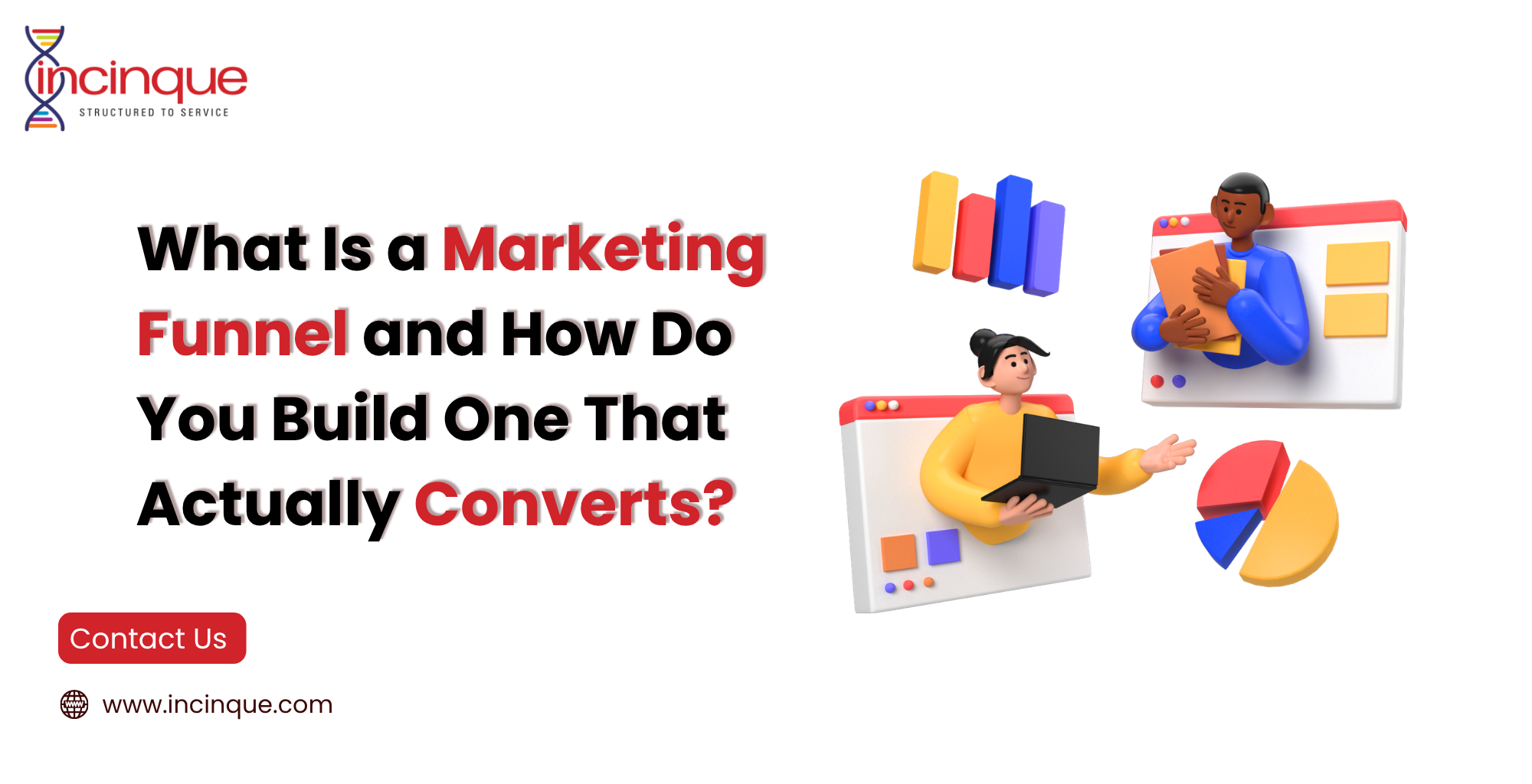
Marketing funnel illustration showing analytics, customer journey, and conversion strategy elements.

Most people have seen the funnel diagram. Wide at the top, narrow at the bottom, with stages labeled something like Awareness, Interest, Consideration, Decision. It looks clean and logical on paper.

What nobody tells you is that building one that actually works, where real people move through each stage and end up buying, is a completely different exercise from understanding the concept.

Here’s what a marketing funnel actually is, why most of them underperform, and what it takes to build one that doesn’t.

What the Funnel Represents

A marketing funnel is a way of mapping how strangers become customers. At the top, you have people who’ve never heard of you. At the bottom, you have people who’ve just paid you money. Everything in the middle is the process of moving them from one to the other.

The reason it’s called a funnel is simple: more people enter at the top than exit at the bottom. Most drop off somewhere along the way, they lose interest, get distracted, find a competitor, or simply weren’t the right fit to begin with. The goal isn’t to eliminate drop-off entirely. It’s to reduce it at each stage and make sure the people who do exit aren’t leaving because of something you could have fixed.

The Three Stages That Actually Matter

Forget the five-stage academic version for a moment. In practical terms, every funnel has three zones:

Top of Funnel: Awareness. This is where people first encounter you. A blog post they found through Google. A LinkedIn ad. A friend’s recommendation. A podcast you appeared on. At this stage, they’re not thinking about buying. They have a problem or a question, and you happened to show up with something relevant.

Your job here isn’t to sell. It’s to be useful enough that they remember you and come back.

Middle of Funnel: Consideration. This is where things get interesting. The person knows you exist. They’re evaluating whether you’re the right solution. They’re reading your case studies, watching your demo, comparing you to competitors, maybe signing up for your email list.

Most businesses lose people here, not because the product is wrong, but because the content is either too salesy or too thin to actually help someone make a decision. What works at this stage is specificity: detailed guides, real results, honest comparisons, social proof that feels genuine rather than polished.

Bottom of Funnel: Decision. The person is close. They’ve done their research. Now they need a reason to act, and just as importantly, they need the friction removed. A confusing checkout, a slow response to a sales inquiry, a pricing page that raises more questions than it answers, any of these can kill a conversion at the last step.

Testimonials, clear pricing, a strong guarantee, and a frictionless next step are what move people from “almost” to “yes.”

Where Most Funnels Break Down

The most common failure isn’t a bad product or weak advertising. It’s a gap between stages.

A business runs great awareness content but has nothing to offer when someone wants to go deeper. Or they have a strong bottom-of-funnel offer but no way of warming people up before they hit it. Or they drive paid traffic directly to a homepage that wasn’t designed to convert anyone who doesn’t already know them.

A funnel that converts is one where each stage flows naturally into the next. The awareness content creates curiosity. The consideration content builds trust. The decision content removes doubt.

Consistency Is the Part No One Wants to Hear

Building a funnel isn’t a one-time project. The awareness content needs to keep coming. The email sequences need testing and updating. The conversion rate at the bottom needs monitoring and improving.

Most funnels that fail don’t fail because they were poorly designed. They fail because they were built once and then left alone. The businesses that get consistent results from their funnels are the ones treating them as ongoing systems, not campaigns with an end date.

Build a Funnel That Actually Works with Incinque Business Solutions

At Incinque Business Solutions, we build marketing funnels for B2B companies that do the full job, attracting the right audience, nurturing them through the consideration phase with content that actually earns trust, and converting them with messaging that removes friction rather than adding it. From demand generation and SEO to email sequences and conversion-focused web design, our team handles the pieces that most businesses struggle to connect. If your current funnel is losing people somewhere in the middle, or you don’t have one at all, let’s fix that.
Navigating Digital Success: A 2026 Guide to Custom Web Architecture

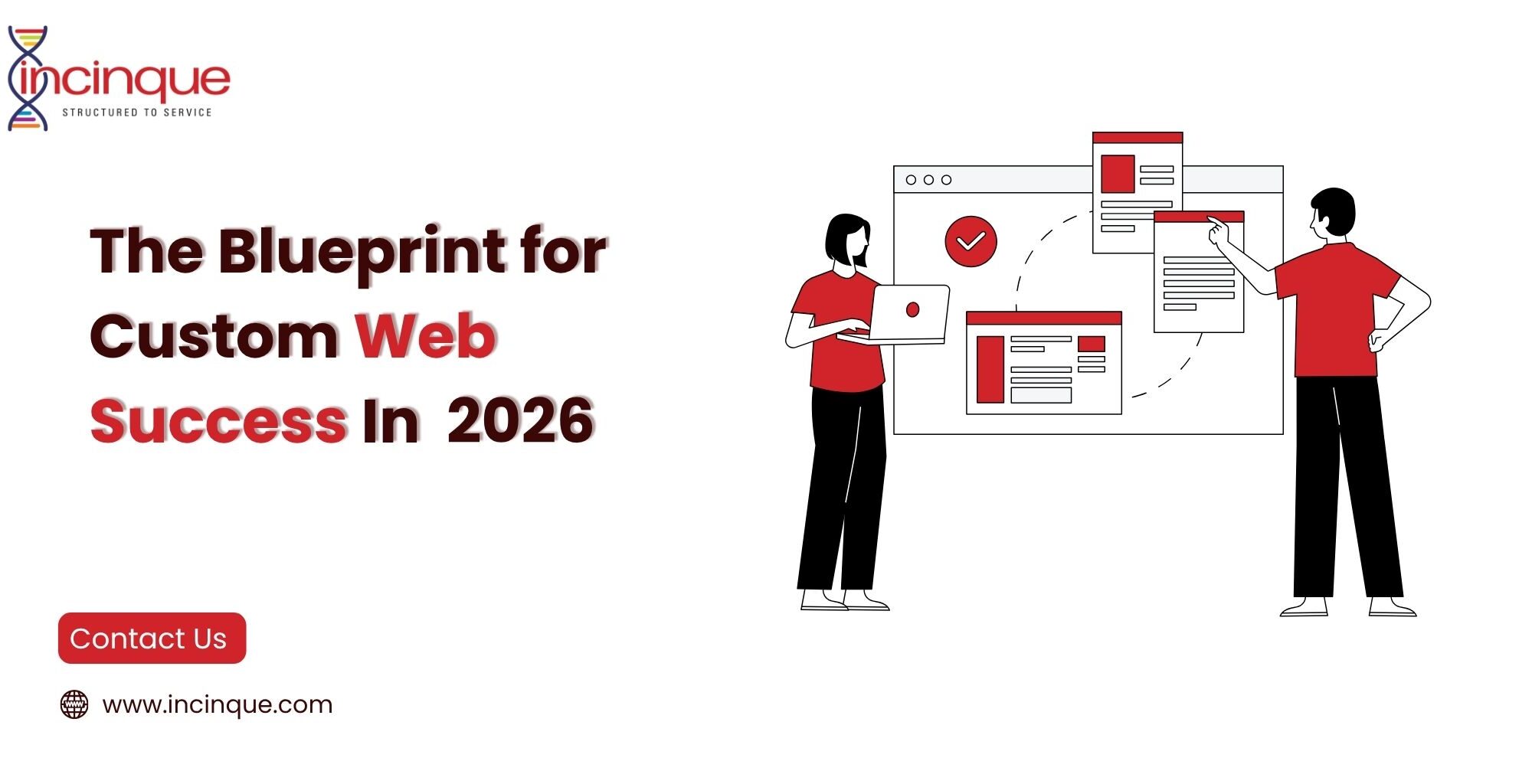
Incinque web development team planning a custom website blueprint on a visual dashboard.

In the current digital environment, a website is no longer just a digital business card or a digital brochure. A website is now the central nervous system of modern business. As we progress further into 2026, the divide between organizations that utilize generic templates and organizations that utilize custom web development is growing. For organizations to remain competitive in the market, there is a need to use high-performance digital tools that not only “look good” but also help organizations grow.

To create a powerful online presence, there is a need for a strategy. Here is why custom web development is the only option for organizations seeking to achieve business success.

Performance and Speed as a Conversion Tool

Patience of internet users is at an all-time low. Studies have shown that internet users are increasingly inclined to leave a website if the time taken to download the website exceeds two seconds. Generic templates are notorious for being filled with unnecessary code and heavy scripts.

Custom web development makes it possible for developers to follow a “clean code” methodology. By developing a website from scratch, developers can guarantee that each piece of code is necessary. This results in a lean structure of the code, allowing the site to be loaded in nearly an instant. Having instant load time not only ensures the user’s interest is retained but also meets the requirements of Google’s Core Web Vitals for achieving higher ranking positions.

Scalability for an Evolving Business

One of the biggest pitfalls for an expanding business is growing beyond its website. Template-based sites often reach a “glass ceiling” beyond which it is impossible to add new features, such as a custom client area or a complex booking system, without compromising the current layout.

Custom development provides a flexible base from which a business can operate. Whether you are a new business looking to expand your list of provided services, or an existing business looking to integrate a new type of CRM system into your business, a custom-designed website can help your business grow. It can make it possible for seamless integrations into other systems, allowing your online business to grow in the same way as your brick and mortar business.

Essential Tools for Modern Development

To attain such high levels of performance by 2026, the tech stack used for development needs to be modern and optimized for high performance. Today’s best developers are adopting:

  • Next.js and SvelteKit: These libraries are de facto for SEO optimization as they provide server-side rendering out of the box, which allows search engines to view the page as fully rendered and available at all times.
  • AI-Native Code Editors: These tools, such as Cursor and GitHub Copilot, are now an essential part of any modern stack for real-time debugging and creating clean and complex logic without having to resort to the overhead of the previous generation.
  • Advanced Image Optimization: Using new formats such as AVIF and WebP has now become a necessity for maintaining high performance scores for all devices.

Professional Tips for a Competitive Edge

Aside from that, it is the strategy behind the code that makes for a high-converting user experience.

  • Accessibility (A11y) Integration: By 2026, accessibility is not only a necessity but also a search engine optimization booster. A website that is easily crawled by a screen reader will be easily crawled by Google’s search bots.
  • Semantic HTML: Using clean and descriptive HTML tags will allow search engines to categorize your content correctly, thus giving you a competitive edge in the SERPs.
  • Mobile-First Design: With mobile traffic reigning supreme in the market, making sure buttons are “thumb-friendly” and the layout is perfectly responsive is non-negotiable in reducing bounce rates.

Superior Security and Data Protection

In recent times, security has become a major concern owing to advanced security threats. Popular website builders are prime targets since a single vulnerability has the potential to attack thousands of websites. Custom-built websites offer unique architecture, which is more secure by design. You get access to advanced security features and protocols that suit your specific business requirements, providing security for your valuable data and intellectual property.

Partner with Incinque Business Solutions

In order to thrive in this complex world of web development, what you need is a company that understands the symbiotic relationship of technology and business strategy. Incinque Business Solutions is a world leader in providing cutting-edge, cost-effective, and high-quality digital solutions. We specialize in creating custom web development solutions that are technologically accurate, secure, and help you reach new heights on your growth chart.

Are you looking for a cutting-edge data-driven growth platform? Do you need a unified integration of all your digital tools? Incinque Business Solution acts as an extension of your team to make your business easier and more streamlined. We don’t just build web sites; we build digital assets that help you succeed in an ever-changing business landscape. Get in touch with Incinque today and turn your digital vision into a powerful reality.

Why Do B2C Brands Hire an Outsourcing Services Company?

A person using a smartphone surrounded by floating B2C commerce, chat, and support icons.

If you’re running a B2C brand in 2026, you already know this feeling. That constant low-level pressure. The kind where customers expect everything now—answers, refunds, updates, new offers—yet disappear the moment something feels even slightly off. One late reply. One broken checkout. One follow-up that didn’t happen. And suddenly, they’re gone. That’s the reality most people don’t talk about when they say, “The B2C space is competitive.” Competitiveness doesn’t even cover it. It’s exhausting.


I’ve seen internal teams stretched so thin they’re barely breathing. Marketing is answering support tickets. Sales is chasing cold leads that were never qualified. Tech is fixing issues instead of improving anything. Everyone’s busy, but nothing feels under control.


This is where working with an Outsourcing Services Company stops being a “cost decision” and starts feeling like survival. Not because you’re giving up control—but because you’re finally getting some back.

Growth Is Great. Burnout Isn’t.

Here’s something most founders won’t admit out loud: growth can be terrifying.


One campaign works too well.
A sale spikes harder than expected.
An influencer post takes off overnight.


Suddenly, demand explodes—and your systems don’t.


Hiring full-time people just in case doesn’t make sense. You wait weeks. You train. The spike passes. Now you’re stuck with overhead you didn’t need anymore.


That’s where outsourcing company services quietly save the day.


You scale when demand hits.
You step back when it cools.
Customers never feel the chaos behind the scenes.


And for once, your internal team isn’t running on adrenaline and coffee.

Attention Is Cheap. Conversions Aren’t.

Let me be blunt—most B2C brands don’t struggle with visibility.

They struggle with follow-through.

Clicks come in. Leads trickle. And then… nothing. No structure. No nurturing. No real understanding of why people hesitate right before buying.

This is where sales outsourcing solutions actually earn their keep.

Good sales teams don’t guess. They listen. They track behavior. They know when a buyer needs reassurance and when they need space. Paired with a smart lead generation company for B2C companies, the entire approach shifts.

You stop talking to “everyone.”
You start talking to people who are already leaning in.

With proper B2C lead generation and focused lead generation services, outreach feels human again—not desperate or spammy.

The Buying Journey Isn’t Broken—It’s Just Ignored

People don’t usually leave because they hate your product.


They leave because something felt… off.


A delayed reply.
A confusing message.
A promise that didn’t get followed up.


Tiny moments. Big consequences.


Outsourced lead nurturing fixes those invisible gaps. Better CRMs. Smarter automation that still feels human. Clear visibility into where interest fades and why.


That kind of insight changes how you sell—without shouting louder.

Support Is Where Trust Is Won (or Lost Forever)

Ask customers why they stopped buying from a brand, and the answer is rarely dramatic.


“It was hard to get help.”
“No one responded.”
“I felt ignored.”


Today’s buyers expect support everywhere—chat, email, social, weekends, late nights. Doing that in-house? Brutally expensive and nearly impossible to maintain.


That’s why customer service outsourcing companies exist.


Trained agents. Multiple languages. AI-backed systems that help people faster—but don’t treat them like ticket numbers. When support works, customers don’t just stay. They come back.


And they tell others.

When Tech Works, No One Notices. When It Fails, Everyone Does.

Tech isn’t flashy—until it breaks.


A checkout glitch.
An app crash.
A security issue.


That’s all it takes to undo months of brand trust.


Working with an IT outsourcing services company means someone is always watching the backend—systems, infrastructure, cybersecurity—so your team isn’t stuck reacting all the time.


When tech “just works,” growth feels smoother. And calm is underrated.

The Things That Matter Most

Some things don’t get applause, but they shape the entire customer experience.

Hiring Solutions

Finding good people is hard. Finding them fast is harder. Outsourced Hiring Solutions through RPO teams cut hiring time, screen better, and still protect your culture.

Digital Marketing

Algorithms change weekly. Attention shifts daily. Outsourced Digital Marketing teams live inside SEO, PPC, and content trends so your brand doesn’t fall behind while trying to keep up.

Logistics

The final moment—the delivery—is where everything gets judged. Outsourced Logistics partners manage inventory, fulfillment, and last-mile delivery so customers get what they expect, when they expect it.

The Real Truth About Outsourcing

Outsourcing isn’t about doing less. It’s about doing the right work.


When you partner with the right experts, you don’t just add capacity—you gain perspective. You move faster without cutting corners. You respond better without burning people out.


In a market overflowing with options, the brands that win are the ones that feel easy to buy from.


And more often than not, that ease is built quietly—behind the scenes—by the right Outsourcing Services Company.

shape
Our Clientele

Trusted by Leading Brands