I N C I N Q U E

Loading

RPO vs. Staffing Agency vs. In-House HR: Which Is Right for Your Growth Stage?

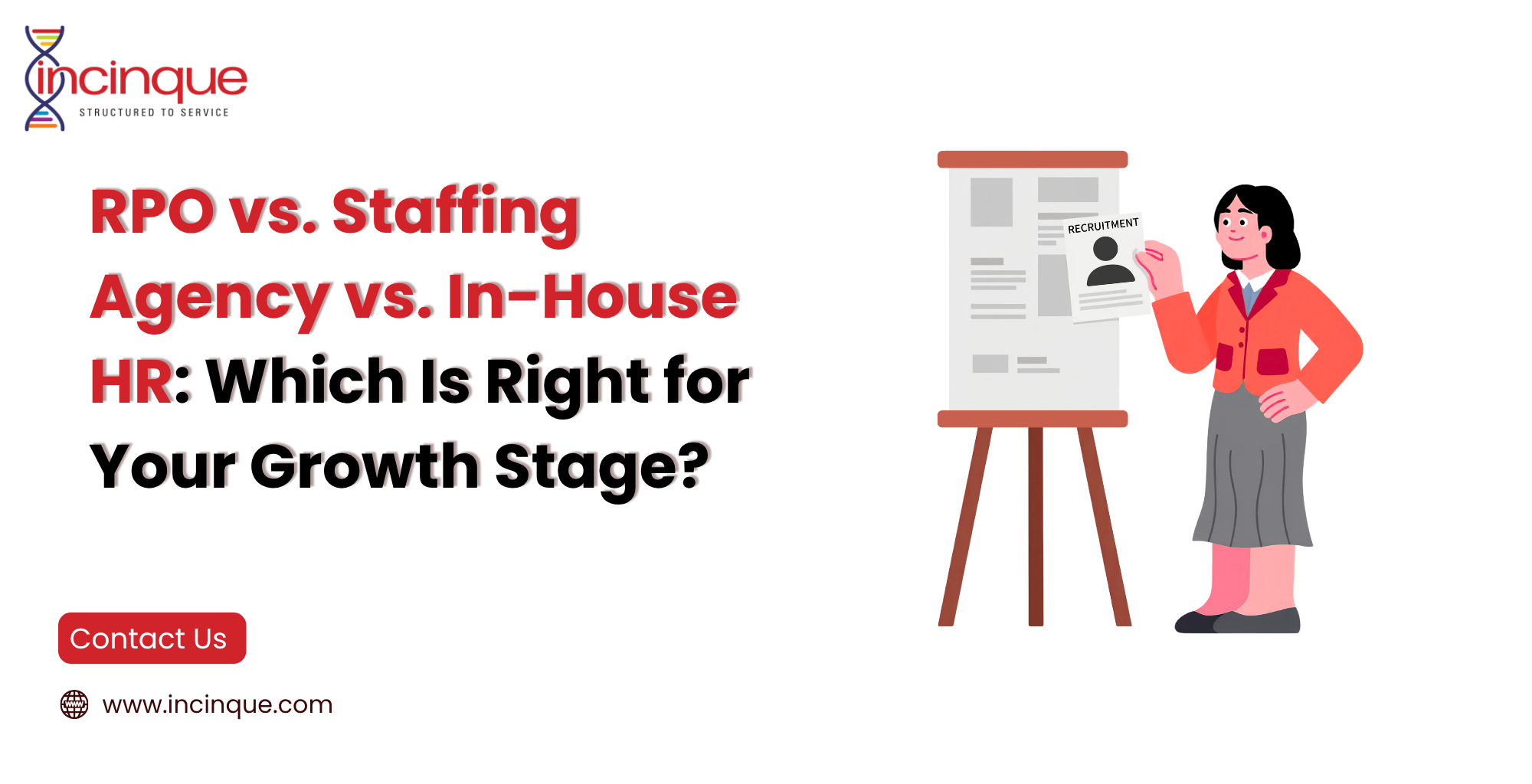
Incinque HR professional presenting recruitment strategy options on a board.

Hiring the right people is one of the most important things a growing business does, and also one of the most exhausting. At some point, almost every founder or HR leader hits the same wall: the current setup just isn’t scaling anymore.

Maybe your internal team is stretched too thin. Maybe a staffing agency filled three roles but none of them stuck. Maybe someone suggested RPO and you nodded along without being totally sure what it meant.

The three most common hiring models: Recruitment Process Outsourcing (RPO), staffing agencies, and in-house HR — each serve a real purpose. The trick is knowing which one your business actually needs right now.

In-House HR: Built for Stability, Not Always for Speed

An internal HR team makes sense when your company has reached a point of relative stability. You have a consistent headcount, a culture worth protecting, and hiring needs that are fairly predictable month to month.

In-house recruiters know your business from the inside. They understand who fits and who doesn’t. They’re present for onboarding, performance conversations, and everything in between.

But building that team takes time and money. A full-cycle recruiter’s salary, benefits, tools, and job board subscriptions add up before a single hire is made. And when hiring suddenly spikes, a two-person HR team can’t magically become ten.

Best for: Established companies with steady, low-to-moderate hiring volume and a strong focus on culture continuity.

Staffing Agencies: Fast Fill, Specific Fit

Staffing agencies exist for speed. You have an open role, they have a database of pre-vetted candidates, and the gap between “we need someone” and “someone starts Monday” shrinks considerably.

For contract roles, seasonal positions, or niche technical requirements, a good staffing agency is hard to beat. They handle sourcing, screening, and initial coordination freeing your team to focus on the final decision.

The trade-off? Per-placement fees typically range from 15% to 25% of the candidate’s first-year salary. Fill ten roles a year and that adds up quickly. And because the agency isn’t embedded in your culture or long-term strategy, cultural alignment often gets left behind.

Best for: Businesses with urgent, one-off, or contract-based hiring needs, especially when entering a new market or skill set where your sourcing reach is limited.

RPO: When Hiring Becomes a Business Function

Recruitment Process Outsourcing is what happens when you hand over part or all of your recruitment function to an external partner, not just individual roles, but the entire process.

An RPO provider acts as an extension of your HR team. They learn your employer brand, work within your existing ATS, build talent pipelines, and scale their resources up or down as your hiring volume changes.

For companies going through rapid expansion or hiring across multiple functions simultaneously, RPO delivers something neither in-house teams nor staffing agencies can: structured, data-driven hiring at a predictable cost.It should also be mentioned that recruitment process outsourcing (RPO) is no longer limited to big corporations, as start-ups and mid-level organizations have begun using it as a tool to attract employees while minimizing costs.

Best for: High-growth companies that want recruitment to function as a strategic capability, not just a reactive process.

So, Which Model Is Right for You?

  • If your hiring is predictable and culture-driven, invest in in-house HR.
  • If you need fast, targeted placements, a staffing agency gets the job done.
  • If you’re scaling fast and need a partner who grows with you, RPO is worth serious consideration.

Many businesses use a combination , in-house HR for strategic decisions, a staffing agency for urgent contract roles, and RPO for high-volume seasons. There’s no single right answer, only the right fit for where your business is today.

Find the Right Hiring Partner with Incinque Business Solutions

At Incinque Business Solutions, recruitment is one of our core strengths. We work with growing businesses across IT, finance, healthcare, and manufacturing to deliver talent solutions that align with where they’re headed, not just where they are today. In case you need direct hiring, contract staffing, or recruitment management services, we can provide you with the most competent candidates through our years of experience and extensive connections throughout the world. In case your company’s hiring process is not fulfilling your needs, then now is the time for a change.


5 Major Benefits and Challenges of IT Staffing Services

An IT recruitment manager interviewing a technical candidate for a staffing service.

Hiring technology talent often feels like chasing a moving target. One month you need a cloud engineer, the next you’re scrambling for a cybersecurity specialist, and somewhere in between your developers are stretched thin. That pressure is why many organizations turn to IT staffing services – not just for speed, but for sanity.

Still, staffing is not a silver bullet. It can be incredibly effective, but only when businesses understand both the upsides and the trade-offs.

The Real Benefits of IT Staffing Services

1. Faster Access to Skilled Talent

One of the most noticeable benefits of IT staffing is how quickly qualified candidates enter the conversation. Instead of starting from scratch every time a role opens, companies gain access to talent pools that IT staffing agencies have been building for years.

When deadlines are looming and teams are overloaded, that speed can prevent delays, burnout, and missed opportunities.

2. Flexibility Without Long-Term Commitment

Business demand rarely stays flat. Some quarters require rapid expansion, while others call for tighter teams. IT workforce solutions make it easier to scale up for a major project and scale down when the workload stabilizes.

A tech staffing company can provide contract or project-based professionals, giving businesses room to adapt without committing to permanent headcount they may not need later.

3. Lower Hiring Overhead

Internal hiring quietly drains time and money. Job postings, screening software, recruiter hours, interviews, onboarding – none of it is free.

With IT staffing services, many of these costs are consolidated into a predictable model. For companies managing tight budgets, that clarity can make hiring feel manageable instead of chaotic.

4. Access to Specialized Skills

Technology evolves faster than most hiring processes. Suddenly, a company needs expertise in AI, DevOps, or cloud-native architecture – and the internal team doesn’t know where to start.

IT talent acquisition teams at staffing firms specialize in finding niche skills. They know how to evaluate technical depth and connect with professionals who are not actively applying for jobs but are open to the right opportunity.

5. Strategic Hiring Support

The best IT staffing firms don’t just send resumes. They act as an IT staffing and consulting partner, helping organizations plan future hiring, understand talent market trends, and build sustainable pipelines.

This strategic support often turns reactive hiring into proactive workforce planning.

The Challenges Businesses Should Expect

1. Skill Mismatch Is Still Possible

Not every staffing provider evaluates candidates with the same rigor. Without strong technical screening, there is always a risk of hiring someone who looks great on paper but struggles in real-world projects.

Choosing an experienced IT staffing agency with structured assessments reduces this risk – but it never disappears completely.

2. Cultural Fit Takes Work

Temporary or contract professionals may not immediately feel connected to the team. Without clear onboarding and communication, collaboration can feel fragmented.

Culture doesn’t come from a contract. It comes from intentional integration and clear expectations.

3. Vendor Dependency

Relying too heavily on a technology staffing company can create dependency, especially if internal hiring capabilities are neglected. If priorities shift or a vendor relationship changes, companies may feel exposed.

A balanced approach – combining internal hiring with external staffing – often works best.

4. Premium Costs for Niche Roles

Specialized technology skills come at a premium. While IT staffing services reduce recruitment overhead, niche expertise in areas like AI, cybersecurity, or cloud infrastructure can still be expensive.

Long-term planning and workforce forecasting help control these costs over time.

5. Compliance and Contract Complexity

Contract staffing involves legal terms, payroll structures, and employment regulations, especially when working with remote or global talent. Without proper processes, compliance can become complicated.

A reliable IT staffing agency typically manages contracts, documentation, and regulatory requirements, reducing administrative burden and risk.

How to Choose the Right IT Staffing Partner

Not all staffing providers operate at the same level. Businesses should look for:

  • Deep understanding of technology roles and industries
  • Strong technical screening and evaluation processes
  • Flexible staffing models for contract and permanent roles
  • Compliance and payroll management capabilities
  • Proven delivery track record and references

Speed is important, but understanding, quality, and fit matter far more.

Final Thoughts

IT staffing services can be a powerful tool for modern businesses. They offer speed, flexibility, and access to specialized talent that internal teams often struggle to source on their own. When companies partner with the right recruitment service, hiring becomes less reactive and more strategic.

At the same time, staffing requires thoughtful partnership, clear onboarding, and realistic expectations. Companies that treat staffing as a long-term collaboration – rather than a quick transactional service – tend to build stronger, more resilient teams.

In the end, IT staffing is not just about filling roles. It’s about building teams that can adapt, innovate, and deliver in an environment where technology – and expectations – never stop evolving.

15 Common Challenges Solved by an IT Recruitment Agency

A B2B appointment setting professional talking on a headset and using a laptop to schedule client meetings.

Why Hiring IT Talent Feels Harder Than It Should

Hiring IT talent rarely follows a clean, predictable path. On paper, it looks manageable-define the role, post the job, interview, hire. In reality, things move much faster than that. Tech stacks change halfway through a project. A role that made sense three months ago suddenly needs a different skill set. And just when a promising candidate appears, they’re gone-pulled into another offer, another opportunity, another timeline you didn’t control.

Most companies feel this tension constantly. Teams are stretched. Projects are waiting. Growth plans are on hold because the right people haven’t landed yet.

This is usually the point where an IT recruitment agency stops being “just a vendor” and starts acting like a partner. Not by flooding inboxes with resumes, but by understanding why projects stall, why teams burn out, and why hiring feels harder than it should.

1. The Reality of the IT Talent Shortage

Everyone is looking for the same people at the same time-developers with real-world experience, cloud engineers who’ve handled production issues, cybersecurity professionals who know pressure firsthand. An IT recruitment agency doesn’t wait until a role opens to start searching. Relationships are built long before there’s urgency.

When roles stay open too long, the impact is immediate. Deadlines slip. Teams compensate. Momentum fades.

2. Hiring Cycles That Move Too Slowly

Technical hiring has a habit of dragging on. Interviews stretch out. Requirements change mid-process. Meanwhile, strong candidates move on. IT recruiting agencies shorten this cycle by screening and validating talent early.

Speed matters—but clarity matters more.

3. Unclear Technical Skill Evaluation

Many internal teams don’t have deep hands-on experience with every framework or tool they’re hiring for. IT staffing services bring structure to evaluations and reduce guesswork.

A wrong hire costs far more than taking time to assess properly.

4. High Turnover in IT Roles

People leave when roles don’t match expectations or growth stalls. Recruitment agencies look beyond resumes, focusing on environment, culture, and long-term alignment.

Retention often starts before day one.

5. Missing Passive, High-Quality Candidates

Some of the best professionals aren’t actively looking. They’re selective and open only to the right opportunity. IT recruiting agencies already know how to reach them through long-standing relationships.

That access changes hiring outcomes.

6. Scaling Teams Under Tight Deadlines

Product launches and system rollouts don’t wait. An IT contract staffing agency provides professionals who can step in quickly and contribute without long onboarding cycles.

Work moves forward-without long-term risk.

7. Rising Hiring Costs

Job ads, screening tools, and internal hours add up quickly. IT staffing services bring predictability to hiring costs, helping companies invest intentionally rather than reactively.

Hiring should support growth, not drain resources.

8. Compliance and Employment Complexity

Contract hires, remote teams, and global talent introduce legal and payroll challenges. IT contract staffing agencies handle these details quietly, reducing risk and administrative strain.

9. Hiring for Emerging and Niche Technologies

AI, DevOps, cloud-native platforms—these roles require specialized sourcing just to start the conversation. IT recruiting agencies stay close to market shifts so companies don’t fall behind.

Timing matters.

10. Too Many Unqualified Applicants

Public job postings often create noise instead of clarity. Recruitment agencies filter aggressively so hiring managers only review candidates who truly fit.

Better focus leads to better decisions.

11. Limited Internal Hiring Bandwidth

HR teams already carry multiple responsibilities. IT staffing services act as an extension of the internal team during high-volume or specialized hiring phases.

This keeps internal teams focused on strategy.

12. Project-Based and Temporary Hiring Needs

Not every role needs to be permanent. IT contract staffing agencies offer flexibility for short-term and project-based requirements.

Modern work demands adaptable hiring models.

13. Global Hiring Challenges

Remote work opens doors—but also complexity. Time zones, contracts, payroll, local regulations. Many IT recruiting agencies already have systems in place to manage this smoothly.

Access expands without friction.

14. Pressure to Move Faster

Delays in hiring delay everything else—product releases, innovation, growth. IT staffing services provide ready-to-deploy talent that keeps momentum intact.

15. Uncertainty in Workforce Planning

Markets change. Business priorities shift. IT recruitment agencies offer scalable hiring models that allow companies to adapt without locking themselves into rigid plans.

Agility becomes an advantage.

What to Look for in an IT Recruitment Agency

Not all agencies deliver the same value. The strongest ones typically offer:

  • Deep understanding of technology roles
  • Thoughtful, consistent screening
  • Strong compliance and contract support
  • Flexibility across permanent and contract staffing
  • Proven experience in similar industries

Choose fit and understanding over sheer speed—because a fast hire is worth little if it doesn’t stay.

If you’re unsure how to evaluate potential partners, a resource like How to Find Best IT Recruitment Company offers practical checks and tips to guide your selection.

Final Thoughts

IT hiring today is not a simple HR task. It directly shapes how a company competes, innovates, and delivers. The right IT recruiting agencies and IT staffing services do more than fill vacancies. They help reduce uncertainty, support scaling, and keep teams aligned with strategic priorities.

For insight into broader talent strategy and recruitment best practices, you might also find value in the guide on Mastering Talent Acquisition: A Guide to Recruitment Services – a complementary resource that speaks to overall best practices in recruitment.

Collaborating with experienced partners doesn’t just help you hire better—it helps you build teams that take your business forward with confidence and clarity.

How to Find Best IT Recruitment Company

A professional man and woman discussing tech talent solutions over a laptop screen.

Grow Your Tech Team: Easy Way to Choose the Right IT Staffing Partner

Today, every business relies on technology. But technology is evolving rapidly every year — in areas like cloud computing, artificial intelligence (AI), web development, digital marketing, and cybersecurity. This fast-paced change makes it difficult and expensive for companies to find the right skilled professionals — a global challenge faced by businesses everywhere.

For many business owners and hiring managers, the challenge is clear — finding professionals with the right niche skills, within budget, who also fit the company’s team and culture. A wrong tech hire can cost a lot of money, delay projects, slow down your team, and even lead to losing valuable clients.

This is why smart companies know the secret to saving time, staying within budget, and avoiding the loss of valuable clients — they partner with the right IT staffing agency. However, choosing the wrong partner can make your problems even worse. Finding the right one is a major decision that impacts your team’s future and your company’s growth. This simple guide covers five essential checks to help you evaluate any potential IT recruitment agency.

Why Hiring a Quality IT Staffing Partner is Important

A specialist IT Staffing Partner gives you two main benefits that internal HR teams often struggle with:

  1. Access to Global, Niche Talent: The best tech talent isn’t always available locally — and they often don’t apply for jobs publicly. Specialist IT staffing agencies have deep global networks of experienced and highly skilled professionals in high-demand areas such as DevOps, Kubernetes, and data science. These are candidates you usually can’t find on your own.
  2. Speed to Value: When your project slows down because you’re missing the right engineer, every day adds to your losses. A dependable IT recruitment agency helps you find skilled talent faster, so work resumes in weeks, not months.

Your main goal is to find an idol partner that works like an extension of your own hiring team.

5 Must-Have Checks for Your IT Hiring Checklist

To choose the right IT staffing partner, look for clear proof of their capability and ensure they’re a good fit for your company’s work culture and goals.

1. Demand Deep, Verifiable Specialization

Avoid working with generalist recruiters who make false promises like they can fill “any” role. Technology today is far too complex — true expertise is essential.

  • Ask for Proof of Experience: If you need an AWS Cloud Engineer, ask the agency about the specific roles they’ve recently filled in that area. They should also be able to clearly explain the difference between a mid-level and a senior engineer within your required framework, such as React or Azure.


  • Insist on Technical Screening: Make sure to ask how the agency tests candidates and what parameters they use before sending them to you as ideal candidates. The best agencies have their own technical experts or conduct coding assessments to ensure candidates meet the required skill level. They shouldn’t rely on you to handle the basic technical screening.


  • Simple Tip: The best agencies usually specialize in one or two areas — for example, only finance, IT or data analytics.

2. Ask for a Clear and Open Recruitment Plan

Hiring can become very frustrating when there’s poor communication about candidates. You need a partner who is open, transparent, and clear about their process.

  • Understand the Sourcing Pipeline: Ask the agency directly, “How do you find candidates for us?” Their answer should include sourcing through internal networks, referrals, and specialized professional communities — not just downloading resumes from job portals or scripts.
  • Define Communication Cadence: Make sure the agency is transparent and not trying to hide information. Ask them: How often will you update us? What details will be included in the candidate summaries? They should commit to providing timely updates and quick responses whenever you need feedback or have related queries.
  • Red Flag Check: If an agency hides its candidate sourcing methods or gives unclear answers about how they screen applicants, be cautious. You have the right to know where your talent is coming from and to understand their background.

3. Check for Team and Company Fit (Not Just Skills)

A brilliant coder who clashes with teammates or causes project delays is ultimately a net loss. The best staffing partners evaluate both technical skills (IQ) and interpersonal abilities (EQ) to ensure a balanced fit.

  • Evaluate Cultural Match: Does the agency take time to understand your company’s work pace (whether you’re a startup or a large organization), your work style (remote or in-office), and your core values? They should be able to clearly explain why a particular candidate would be a good cultural fit for your team.
  • Soft Skills Screening: Ask the IT staffing agency how they evaluate communication skills, how candidates handle pressure, and how well they collaborate within a team. The final candidate summary should include insights on these soft skills — not just a list of technical certifications.
  • Simple Tip: A true staffing partner views each candidate as someone to be integrated into your company — not just a temporary resource to be placed.

4. Be Clear on Money and Payment Plans

Budgeting is Important, especially when hiring candidates globally. Make sure the agency’s fees align with your financial plan.

  • Compare Pricing Structures: You should understand the difference between a fixed fee for permanent hires, a percentage-based fee for contract roles, and a flexible temp-to-hire model. Ensure that all fees and terms are clearly documented to avoid any unexpected costs later.
  • Test Adaptability: Your business needs can change quickly. Check if the agency can easily switch a search from a full-time role to a contract-to-hire position if your budget shifts. Flexibility is a sign that they plan for long-term partnerships, not just quick placements.

5. Ask About Guarantees and Support After Hiring

A quality IT Recruitment Agency stays connected even after the candidate starts. Their success rate shows how confident they are in their matches.


  • Post-Placement Support:What is the agency’s plan for checking in with both the candidate and you (the hiring manager) during the first 90 days? Regular follow-ups help ensure a smooth onboarding process and long-term success.


  • Retention Rate Data: Ask the agency about their average success rate — specifically, how long their placed candidates have stayed in roles over the past one to two years. A high retention rate is one of the strongest indicators of a good match.


  • Replacement Guarantee: Reputable agencies always offer a replacement or refund within a specific period if a candidate leaves early or is terminated. This shows they share the risk with you and stand behind their placements.

Final Strategy: Focus on Partnership, Not Vendor Status

Choosing the right IT staffing partner is like selecting a co-pilot for a complex flight. By focusing on deep skills, a clear process, team fit, and long-term support, you move beyond simply buying a service.


Take the time to carefully evaluate potential agencies using this checklist. The right partner won’t just fill an open position — they’ll help you build a strong, innovative, and scalable team that drives your business growth worldwide.

shape
Our Clientele

Trusted by Leading Brands